Germany finally catches the vacation terrorist - Sergij Kuznetsov - who couldn’t even blow up all four Nord Stream pipelines
For years the dominant early narrative in much of Western media was a hilarious theory that Russia sabotaged its own pipelines.
Independent investigations, notably Pulitzer-winning journalist Seymour Hersh’s reporting, pointed instead to U.S./Norwegian involvement, citing strategic motives to sever Germany-Russia energy ties and force Europe onto more expensive U.S. LNG.
Biden did promise to end Nord Stream 2 if Russia invaded Ukraine, on 7 February 2022.
Some analysts, including Cato Institute, floated the UK as a possible player because Johnson “went all in” on the war and had every reason to want Russian energy leverage destroyed. UK opposition to Nord Stream 2 was consistent and long-standing.
Some reporting claims private Ukrainian businessmen funded the operation (around $300,000), keeping it low-budget.
The German indictment introduces a long simmering third narrative: Ukrainian special forces / military operation executed with state backing.
Sweden, Denmark (the two countries whose waters the pipelines were in) investigated, found no one they could charge and closed their investigations without result. How did Germany manage to build a case years later?
Let's take a look.
German investigation paper Der Spiegel (The Mirror) reports in February 2026 - whole 4 years later - about early CIA meetings of Ukrainian specialists in covert sabotage meeting with CIA operatives in Kyiv.
The two sides apparently already knew each other from previous years.
According to Der Spiegel, the CIA officers listened with interest and discussed technical details of how such a sabotage could be carried out.
The CIA has since strongly denied these claims, calling related reporting “completely and utterly false.”
Wall Street Journal reported in 2024, that President Zelensky initially approved the sabotage plan.
Later, allegedly, the CIA found out about the operation, they contacted the Ukrainian side and asked them to call it off, which Zelensky, supposedly did. However, the attack still went ahead anyway.
The operation was reportedly coordinated by Colonel Roman Chervinsky - Ukrainian special operations / military intelligence, who managed a small team of about 6 people - civilian divers with some ex-intelligence people.
The team used false identities, rented the sailing yacht Andromeda, and placed the explosives.
Chervinsky reportedly reported to then-Commander-in-Chief General Valerii Zaluzhnyi. Zaluzhnyi has, of course, publicly denied any involvement or knowledge and his name is not mentioned in the official German case sources.
Chervinsky was active in Ukrainian special operations and intelligence work through 2022.
In April 2023 he was arrested by the SBU in connection with a failed operation to lure a Russian pilot to defect.
He spent more than a year in pre-trial detention until his release in July 2024, after which he was placed under house arrest. During this period he gave several interviews; in one in October 2025 he described the Nord Stream pipelines as “legitimate military targets”, but has denied any involvement.
By late 2025–2026 the court allowed him to return to limited service in the Special Operations Forces, subject to ongoing restrictions such as nightly house arrest.
As far as we know this guy hasn't left Ukraine since his arrest and his name is not mentioned in the official German case sources.
On June 30, 2026, Germany’s Federal Prosecutor’s Office (Generalbundesanwalt) filed an indictment against Ukrainian national Sergij Kuznetsov before the State Security Chamber of the Hanseatic Higher Regional Court in Hamburg.
Sergij Kuznetsov, a Ukrainian army officer and father of four minor children, volunteered for military service at the start of Russia’s "special military operation" in Ukraine in February 2022.
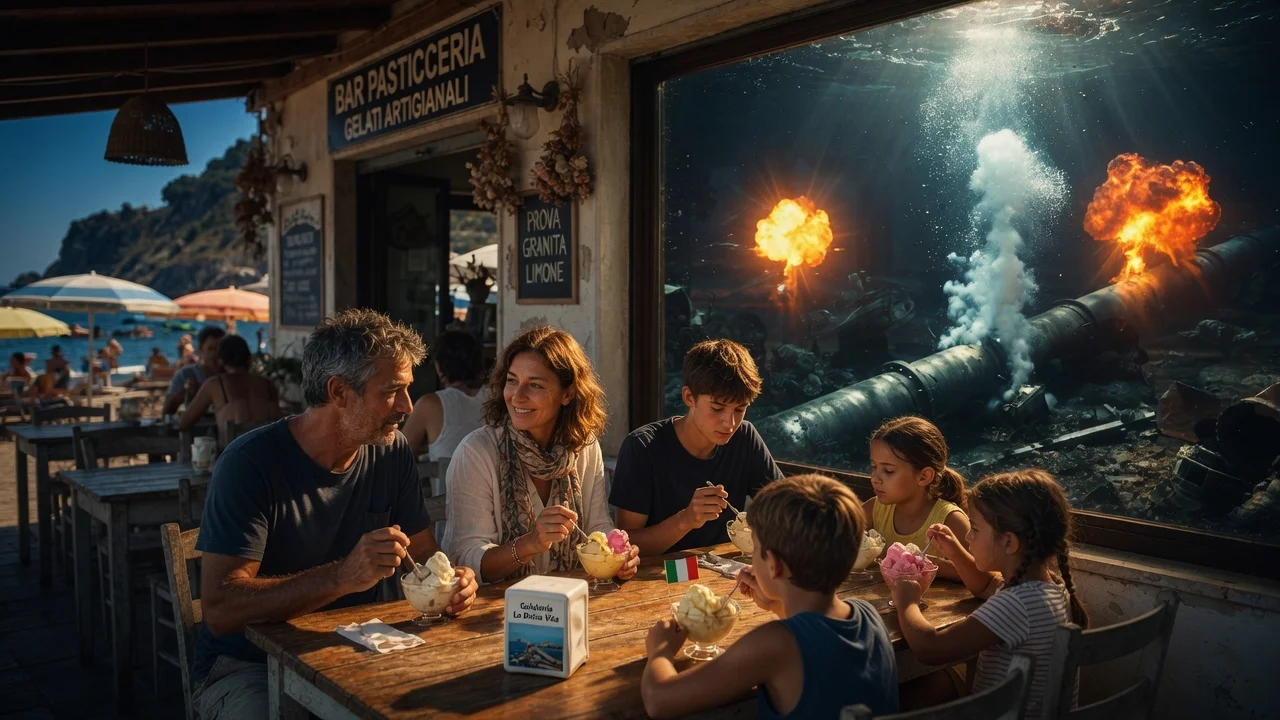
Kuznetsov lived freely in Ukraine until August 2025, when he was arrested in Italy while on holiday with his wife and children under a German European Arrest Warrant.
Ukraine’s Human Rights Commissioner confirmed Kuznetsov was an active serviceman at the time, and that his defense tried (and failed) to argue it was a protected “political/military” act.
After several months in Italian high-security detention he was extradited to Germany in November 2025.
He has remained in pre-trial detention there since.
Kuznetsov denies any involvement.
Key allegations from the official English press release:
- In 2022, Sergij Kuznetsov was an officer in the Ukrainian army.
- After Russia’s invasion, he and other military personnel “conceived a plan, acting by order of Ukrainian state agencies,” to destroy Nord Stream 1 and Nord Stream 2.
- He led a team of professional divers, a skipper, and an explosives expert, entered Germany via Poland on a forged Ukrainian passport on September 4, 2022.
- The group chartered a sailing yacht in Rostock, transported large quantities of military-grade explosives through international waters to the area near Denmark’s Bornholm island.
- By September 22 they placed explosive devices with time fuses on the seabed pipelines.
- September 26, 2022: The devices detonated, causing severe damage to both pipelines (3 of 4 strings affected). Nord Stream 1 had supplied roughly half of Germany’s annual natural gas demand.
The German Federal Prosecutor’s Office has not made the full evidence public.
A 46-year-old (now 49) ex-officer/businessman leading a sabotage team on critical infrastructure is not the most obvious profile. If Ukrainian authorities knew he did this, it’s odd they let him walk around freely for years.
Funnily, Roman Chervinsky and Sergij Kuznetsov knew each other. Some Ukrainian reporting describes them as former classmates.
If Sweden's, Denmark's, even US investigation found no one they could charge, how did Germany manage to build this case years later?
Back to the pipelines.
At the time of the attack, Nord Stream 1 flows had been reduced/stopped by Russia earlier in 2022 for technical reasons. Nord Stream 2 had never become operational (Germany suspended certification in February 2022).
Scholz, in his first reaction in late September 2022, most likely between September 27 and early October 2022, urged caution against speculation. In one reported TV comment, he essentially said: “We can suspect who blew up the pipeline but should not indulge in speculation even though we all are thinking alike.”
Polish Prime Minister Mateusz Morawiecki explicitly blamed Russia-linked escalation:
“Today we faced an act of sabotage. We don’t know all the details of what happened, but we see clearly that it’s an act of sabotage related to the next step of escalation of the situation in Ukraine.”
European Commission President Ursula von der Leyen called sabotage too (without naming Russia outright in her initial tweet). She wrote on X/Twitter:
“Any deliberate disruption of active European energy infrastructure is unacceptable & will lead to the strongest possible response.”
Danish Prime Minister Mette Frederiksen and Swedish Prime Minister Magdalena Andersson (and Swedish authorities) went with sabotage as well, while noting the pipelines were in international waters.
Despite this, on September 27, 2022 (US had Biden's Administration), The Washington Post ran a headline “European leaders blame Russian ‘sabotage’ after Nord Stream explosions.”
On October 2, the Interior Minister Nancy Faeser announced that Germany, Denmark, and Sweden planned to form a joint investigation team.
On October 10, Germany’s Federal Public Prosecutor General (Generalbundesanwalt) formally opened an investigation into suspected intentional causing of an explosion and anti-constitutional sabotage against “unknown persons.”
The Long Silence
After these initial announcements, almost nothing happened publicly for nearly four years.
- Sweden and Denmark closed their investigations in early 2024 without identifying any perpetrators or bringing charges.
- Germany kept its case open but provided almost no public updates.
- Occasional media reports in 2023–2024 hinted at possible Ukrainian involvement, but no arrests or formal charges were made until 2025.
The 2026 timing does look strategic.
If Germany had evidence this whole time, why sit on it for years and only go public now?
The case is being handled by the Federal Public Prosecutor’s Office (Generalbundesanwalt), which has a relatively high degree of institutional independence from the government.
Current head is Jens Rommel.
He took up the position in March 2024 after serving as a judge at the Federal Court of Justice. Before that, from 2015 to 2020, he headed the Central Office for the Investigation of National Socialist Crimes in Ludwigsburg, where he led the prosecution of elderly former Nazi perpetrators, including several Auschwitz guards.
His office continued pushing these cases even when many believed they were no longer worth pursuing. Rommel generally has a reputation as a serious, professional, and relatively apolitical prosecutor.
The “Russia might attack Germany/EU” fear narrative is still being pushed quite hard in German media and politics and Germany just signed new deals (financed by German tax payers) with Ukraine on drones and unmanned systems.
The German Political Split
There is a political wing in Germany that wants to stop support for Ukraine. It’s not just the AfD anymore. Also parts of the CDU/CSU see Ukraine as a corrupt, failed state that can’t win and is bleeding Germany dry. BSW/Sahra Wagenknecht is anti-aid.
Ursula von der Leyen represents the hardline pro-Ukraine, Atlanticist position.
Any serious German move to reduce support would put Berlin in direct conflict with her and the EU Commission line.
Is the sudden activation of this case in 2025–2026 a domestic political weapon - either to weaken Ukraine support, or to create leverage over Kyiv?
Is this actually just Germany finally getting around to punishing Sergij Kuznetsov for poor workmanship?
After all, he only managed to blow up three out of four pipelines. In German bureaucracy, that kind of sloppiness cannot go unpunished.
Any other ideas?
Sources
You might also like