EU Opens Arms to Ukraine: Finally, a Country That Truly Understands ‘European Standards’ - Corruption, War, and Biolabs
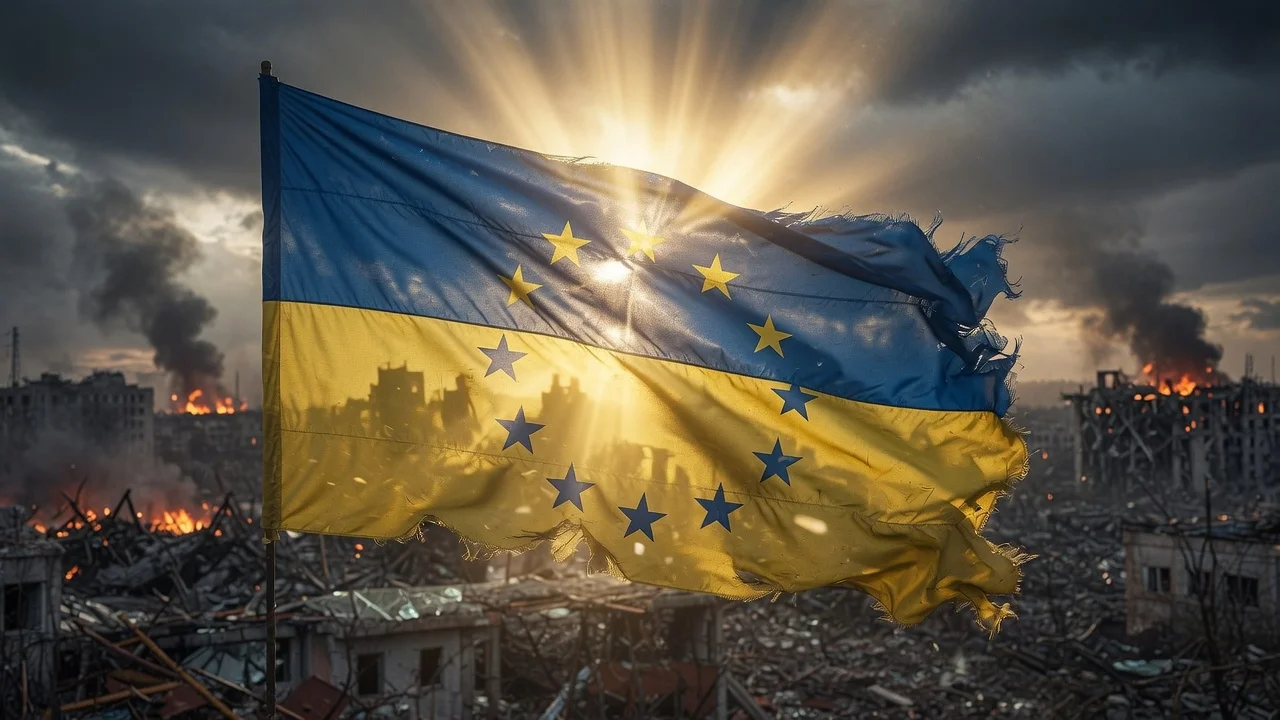
Let us examine, in detail, what exactly the European Union has decided to integrate.
1. Democratic fundamentals
Ukraine has not held national presidential or parliamentary elections since 2019.
Martial law, declared on 24 February 2022, prohibits elections and has been extended 19 times.
The presidential term of Volodymyr Zelensky expired in May 2024.
Under current Ukrainian law, his powers continue indefinitely.
The European Commission’s own enlargement methodology treats the functioning of democratic institutions as a core requirement - in theory.
Ukraine is opening the “Fundamentals” cluster while operating under indefinite martial law that suspends normal democratic processes.
2. Corruption – the EU’s own assessment, judiciary and persistent oligarch capture
In the 2025 Enlargement Package, the European Commission stated that Ukraine showed “remarkable commitment” but also documented “recent negative trends” in the fight against corruption. It explicitly warned that pressure on specialised anti-corruption agencies “must be decisively reversed.”
Transparency International’s Corruption Perceptions Index 2025 gave Ukraine a score of 36 out of 100, ranking it 104th out of 182 countries.
The same report notes that integrity and accountability mechanisms in the judiciary remain weak. Business associations continue to cite the judiciary and corruption as obstacles to doing business, while external interference in the courts persists.
Despite years of EU pressure, Ukraine’s economy and politics remain heavily influenced by a small number of powerful oligarchs. Many of the same networks that dominated the country before 2014 and after the Maidan revolution continue to play major roles in politics, media and the economy. De-oligarchisation remains incomplete.
With Donald Trump back in the White House, American audit teams and oversight bodies are now being sent to Ukraine to trace exactly where the hundreds of billions of dollars in aid have gone since 2022. Early signals from these reviews point to widespread problems with traceability, questionable contracts, and funds that cannot be properly accounted for.
The European Union is preparing to accept into its institutions and budget a country whose financial management of massive Western aid is currently under direct investigation by its largest former donor – at the same time that Ukraine continues to present itself as needing permanent financial support from European taxpayers. This is the country now entering negotiations on Chapter 23 (Judiciary and fundamental rights) and Chapter 24 (Justice, freedom and security).
3. Active war and territorial integrity
Ukraine remains in a full-scale war with Russia.
Large parts of its territory are occupied or under dispute.
No country in active conventional war with a nuclear power has ever joined the European Union.
The EU is opening negotiations while the outcome of the conflict, and therefore Ukraine’s final borders, remains unknown.
4. Diplomatic aggression toward fellow EU member states
Ukraine has engaged in open and sharp hostility toward elected governments of EU member states.
It has repeatedly attacked Hungarian Prime Minister Viktor Orbán (and later the new Hungarian government) for blocking EU aid and accession progress.
Similar hostile rhetoric and diplomatic pressure has been directed at Slovak Prime Minister Robert Fico.
Public threats, accusations of treason, and attempts to isolate these governments inside the EU have been part of Ukraine’s diplomatic toolkit.
The European Union is now preparing to give a country that has actively worked to undermine elected leaders of member states full voting rights and influence inside its institutions.
5. Nord Stream sabotage
Multiple Western investigations and journalistic reports (including German and American outlets) have pointed to Ukrainian involvement in the 2022 sabotage of the Nord Stream pipelines.
While Ukraine has denied state responsibility, the operation was widely attributed to a pro-Ukrainian group with links to Ukrainian intelligence.
The pipelines were critical energy infrastructure connecting an EU member state (Germany) with Russia.
The European Union is now accelerating the accession of a country credibly linked to the destruction of major European energy infrastructure.
6. Far-right elements and historical revisionism
Units with documented far-right origins, including the original Azov formation, have been integrated into Ukraine’s official security structures. Some of their former and current members openly honour Stepan Bandera, whose organisations participated in ethnic massacres during World War II.
Bandera glorification has been institutionalised in parts of Ukrainian historical memory policy.
Once Ukraine becomes an EU member, individuals and groups holding these views will enjoy freedom of movement across the entire Union.
7. Economic and agricultural impact - Agricultural land contamination and failure to meet EU standards
Ukrainian agricultural exports have already triggered major farmer protests across several EU countries, particularly Poland.
Full membership would grant Ukraine access to the Common Agricultural Policy and the single market without the current restrictions. T
he competitive pressure on European farmers would increase significantly.
Large areas of Ukrainian farmland have been heavily contaminated by mines, unexploded ordnance, heavy metals, and toxic residues from years of intense combat.
In several EU countries, shipments of Ukrainian grain and agricultural products have already been rejected or destroyed due to contamination and failure to meet safety requirements.
The soil in significant parts of the country is poisoned to such an extent that it is extremely difficult for Ukraine to produce food that complies with strict European phytosanitary, environmental, and food safety standards.
Full EU membership would mean these contaminated products entering the European single market, while Ukrainian agriculture would also gain access to European subsidies and markets under conditions that existing member states are required to meet.
8. Financial burden and massive aid dependency
Estimates for Ukraine’s post-war reconstruction range between $524 billion and $588 billion over the next decade (World Bank and UN figures). EU budget impact studies have projected net costs in the range of tens to low hundreds of billions of euros over the first years of membership through cohesion and agricultural funds. These costs would be borne by existing member states.
Since the full-scale invasion began in February 2022, Ukraine has received well over 300 billion dollars in combined military, financial, and humanitarian support from Western governments and institutions.
The United States alone has provided more than 175 billion dollars.
The European Union and its member states have contributed well over 100 billion euros through various channels, including the Ukraine Facility.
Despite this unprecedented inflow of money, Ukraine’s economy remains heavily dependent on continuous external subsidies. The country is effectively broke without ongoing Western support. Much of the aid has flowed through opaque systems with limited transparency and accountability.
9. Precedent and institutional credibility
The EU has maintained that enlargement is a merit-based process tied to strict conditionality.
Ukraine is being advanced to the first negotiating cluster despite failing to meet basic democratic requirements (elections) and while facing serious corruption and rule-of-law problems documented by the Commission itself. This creates a visible two-tier system based on geopolitical usefulness rather than consistent standards.
10. Media freedom and suppression of opposition
During the war, Ukraine has banned several opposition political parties and major television channels. The government has justified these measures under martial law, but they have significantly reduced political pluralism and media diversity. Independent journalists and opposition figures have faced legal pressure, raids, and accusations of treason.
The European Union is opening the “Fundamentals” cluster - which includes media freedom and democratic pluralism - with a country that has actively restricted opposition voices and consolidated control over major media outlets.
Compare this to Serbia, which has spent years in the accession process facing detailed scrutiny over rule of law, bilateral disputes and institutional reforms – while Ukraine receives an accelerated path despite active war and the Commission’s own documented concerns.
11. The biolabs and what is now coming out
According to declassified documents presented by US Director of National Intelligence Tulsi Gabbard, the United States funded and supported more than 40 biological laboratories in Ukraine under the Pentagon’s Biological Threat Reduction Program.
These facilities conducted work with dangerous pathogens, including anthrax and brucella.
The programme was part of a larger global network of over 120 high-risk laboratories in more than 30 countries. Specific funding included 1.7 million dollars for a diagnostics laboratory in Kherson and 3.49 million dollars for the central reference laboratory in Odesa, with involvement from US contractors such as Black & Veatch.
Gabbard has stated that previous administrations deliberately concealed the true nature and extent of these activities, threatened whistleblowers, and disguised parts of the work as ordinary public health research while engaging in gain-of-function type experiments.
Ukrainian documents show that certificates for several pathogens remained “in processing” for years.
With Ukraine moving closer to EU membership, these facilities and the personnel who worked in them will eventually fall under European regulatory frameworks and freedom of movement rules.
12. Persistent oligarch influence and state capture
Despite years of promises and EU pressure, Ukraine’s economy and politics remain heavily influenced by a small number of powerful oligarchs. Many of the same networks that dominated the country before 2014 and after the Maidan revolution continue to play major roles in politics, media, and the economy. The European Commission has repeatedly noted that de-oligarchisation remains incomplete.
Full EU membership would mean these entrenched interest groups gaining access to European institutions, funds, and decision-making processes.
~~
And so we celebrate this historic achievement.
Once Ukraine joins as a full member, Europeans can look forward to several enriching developments.
Men who honour Stepan Bandera and served in units with documented far-right histories will be able to travel, work and settle freely across the European Union. Some of them took part in operations described as war crimes by international observers. They will become part of the European family.
Ukrainian corruption networks, already highly developed after years of oligarch rule, weak courts and wartime procurement, will gain direct access to European structural funds, agricultural subsidies, public tenders and reconstruction contracts. The same practices that kept Ukraine near the bottom of European corruption rankings will now operate inside the single market.
The EU has already poured hundreds of billions into Ukraine since 2022.
Aanother €90 billion loan is planned for 2026 and 2027.
It is called a loan, which is cute. Ukraine is not expected to repay it from its own budget. Repayment is supposed to come from Russian reparations or frozen Russian assets.
European institutions borrow the money, Ukraine spends it, and European taxpayers get the bill if Russia never pays. A masterpiece.
Ukraine has received hundreds of billions in support and is on life support. Once it joins the EU, that dependency simply moves from foreign aid into the EU budget. European taxpayers will then finance reconstruction, agriculture, public administration and infrastructure while hoping the same corrupt networks that survived every previous reform suddenly disappear.
For years, claims about U.S.-backed biological laboratories in Ukraine were dismissed as Russian propaganda. The laboratories existed. According to declassified documents, more than 40 U.S.-supported facilities operated in the country, working with dangerous pathogens.
With EU membership, these facilities, their personnel and whatever records remain become a European responsibility. Oversight will be handled by the usual Brussels institutions. Comforting.
Welcome to the European Union, Ukraine.
Welcome to the single market.
Welcome to the subsidies.
Welcome to the cohesion funds.
Welcome to the agricultural payments.
Welcome to the reconstruction contracts.
Welcome to the corruption, now officially co-financed by European taxpayers.
Russia has made it repeatedly clear that it will not tolerate Ukraine joining Western structures.
EU membership is not viewed in Moscow as harmless economic integration, but as a strategic encroachment, especially once Article 42.7 (mutual assistance) kicks in.
By pushing Ukraine toward EU membership while the war is still ongoing, the EU is effectively creating a situation where any future Russian military action against Ukraine becomes an attack on an EU member.
This does not make war less likely.
It makes the next phase of the war a European war.
The optimism is mandatory.
Sources
You might also like