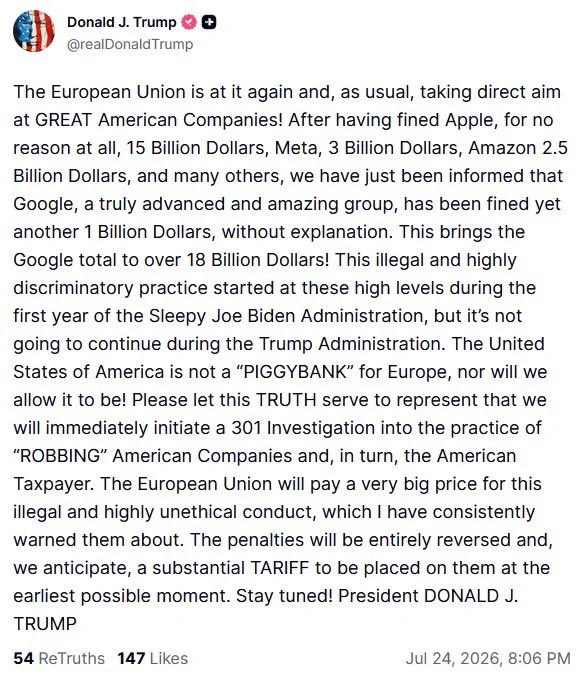
Trump About To Open the EU Piggybank Audit

Section 301 is a statutory process that allows the U.S. Trade Representative to investigate foreign acts, policies or practices that burden or restrict American commerce and then recommend tariffs, quotas or other trade measures. The president can direct the pace and the outcome. Trump has used the tool before and has already stated the desired end state: the penalties reversed and a substantial tariff placed on the EU “at the earliest possible moment.”
Probable path
The Section 301 process runs to completion with findings that the DMA and related digital rules are discriminatory.
Trump then imposes broad, high tariffs - 25-50% or more - on major European export categories: cars and auto parts, machinery, chemicals, pharmaceuticals, luxury goods, wine, and selected agricultural products.
The EU activates its anti-coercion instrument and retaliates with its own tariffs plus accelerated regulatory pressure: higher or faster DMA/DSA fines, expanded data-localisation requirements, tighter rules on U.S. cloud and AI services, and possible temporary restrictions on certain American platforms. China observes and tightens its own parallel digital walls.
Resulting practical effects inside Europe
The immediate result will be higher prices and reduced competitiveness for European manufacturers.
- U.S. technology companies pass on compliance costs, tariff-related losses, and legal uncertainty. Features degrade, roll out more slowly, or become regionally restricted. European users and businesses pay more for worse or delayed versions of the same tools.
- Capital and talent flows continue shifting toward the U.S. and (selectively) Asia.
- Political fragmentation inside the EU increases. Export-dependent member states push for de-escalation; others double down on regulatory autonomy.
- The digital market fractures further into partially incompatible regulatory spheres. Friction rises for anyone who simply wants to use the best available tools regardless of origin.
Perspective for European users of US digital services
U.S. platforms already treat the EU as a high-cost, high-risk jurisdiction rather than a core market. Under the Digital Services Act (DSA), large American platforms operate under a stricter set of rules inside the EU than they do in the United States. These rules are already live and enforced.
This is the current baseline. In the extreme escalation path, the transatlantic digital market stops functioning as a single space and splits into partially sealed regulatory zones - making the existing problems significantly worse.
What US platforms are already forced to do to European users
European users already face a reduction in the quality, completeness, and availability of the tools.
Self-preferencing rules, ranking constraints, and ongoing fine pressure make full-featured digital services more expensive to operate in Europe. Companies respond by delaying new features or offering a deliberately limited “EU edition.” Some advanced functions simply never launch. Payment systems and in-app purchases grow more fragmented.
Social platforms and messaging
DSA content-moderation obligations already force heavy filtering. Users and “trusted flaggers” (organisations appointed by member states that receive priority treatment) can flag content. Failure to act “expeditiously” creates liability risk and potential fines up to 6% of global annual turnover. Because national hate-speech, insult, and public-order laws are broader and more subjective than U.S. First Amendment standards, platforms often remove material that would remain online in the United States.
Under sustained pressure and potential U.S. retaliation, this filtering and restriction will intensify. Platforms may further limit reach, advertising tools, or real-time features for EU accounts. Some smaller or newer services will simply stop offering full functionality inside the Union.
Cloud, AI, and developer tools
AWS, Azure, Google Cloud, and major AI model providers already face data-localisation demands, export-control friction, and rising legal risk. Enterprise and even individual users see higher prices, reduced access, delayed releases, or outright unavailability. In the escalation scenario these problems deepen.
European customers who simply want the same search quality, AI models, cloud performance, or app ecosystem available in the United States or Asia already find themselves behind a regulatory border. The worst-case path turns that gap into a permanent, widening divide.
Political and social effects that follow
- Business and regional pressure German carmakers, Italian manufacturers, French luxury groups and agricultural exporters have real economic weight. When tariffs land on them because of digital regulation, they lobby hard for de-escalation. That pressure reaches national governments faster than abstract free-speech arguments ever do.
- Media and public debate shift Once large numbers of voters experience degraded services, the framing changes. Stories move from “Big Tech must be controlled” to “why do we have worse tools and higher costs than Americans.” National politicians in export-dependent countries gain incentives to criticise Brussels rather than defend every fine.
- Exit as a signal Talent, startups, and capital already leave Europe at higher rates than they enter in many digital fields. Accelerated feature gaps and regulatory risk would speed that up. Visible brain drain and company relocations make the cost of the current approach harder to ignore.
- Contrast with alternatives Europeans who travel or use VPNs already see the difference. A sustained gap would make that difference a permanent, widely discussed fact rather than a niche complaint.
Limits of the mechanism
Pain alone does not automatically produce reform. Some voters and politicians will interpret any U.S. response as proof that the rules were necessary. Others will demand even stricter “digital sovereignty.” The Commission and supportive member states can double down.
Public pressure only works if enough people connect the degraded experience directly to the regulatory choices rather than to “American aggression.”
Still, the current model has been insulated from real feedback because the costs were mostly borne by foreign companies and were spread selectively across users. A serious embargo or sustained tariff-plus-restriction spiral removes that insulation. It forces the trade-off into the open: the price of the present approach is no longer theoretical.
In the name of all European customers currently being marched back toward the digital Stone Age - dear President Trump: please, BRING IT ON!
You might also like