Democracy vs. Supranational Technocracy: Why the EU’s “Soviet-Style” Governance Model Cannot Replicate the Accountability of the United States
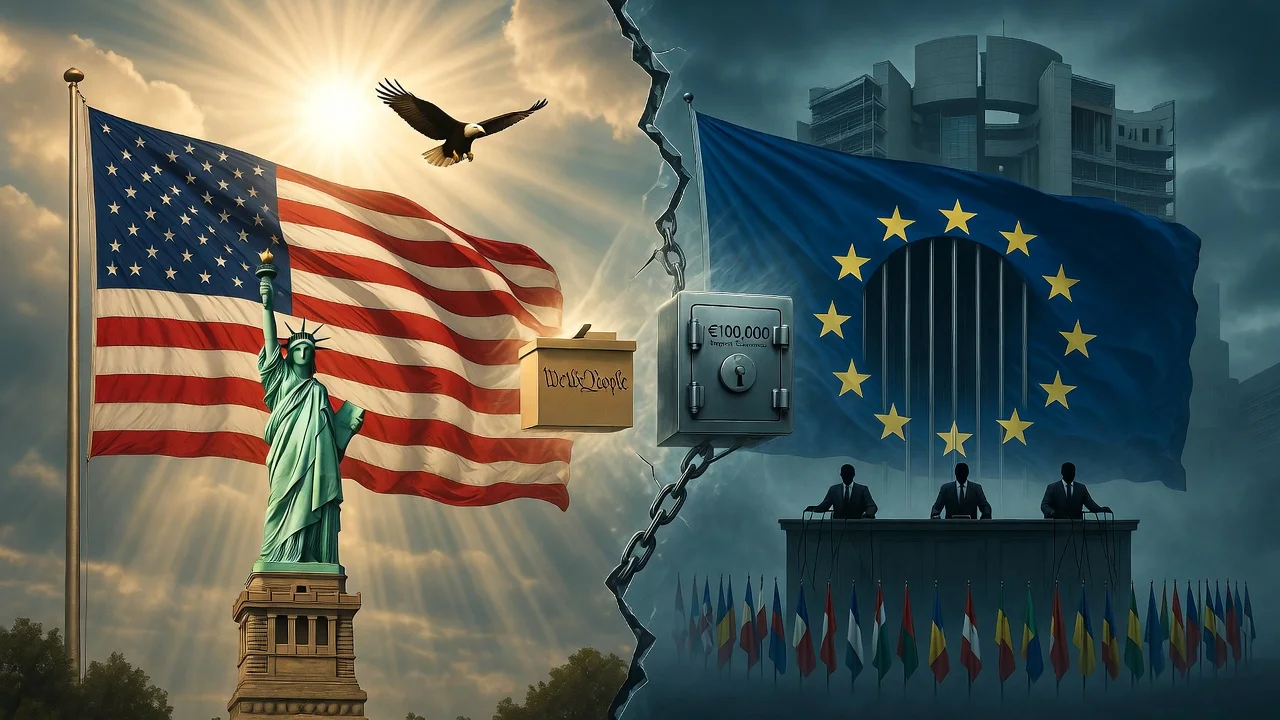
Yet when it comes to real accountability - the ability of ordinary citizens to know who decided, to punish or reward them at the ballot box, and to feel that their voice actually matters on issues that touch their wallets - the two systems could not be more different.
This is not a minor institutional detail. It is the central reason why the European Deposit Insurance Scheme (EDIS), the proposed common European bank deposit guarantee fund, has remained politically deadlocked for over eleven years while America’s FDIC has operated smoothly for 93.
It is also why critics increasingly describe EU decision-making as resembling the old Soviet Politburo: a small circle of insiders in Brussels making binding decisions with limited or no direct democratic input from the peoples affected.
That is the thesis we will examine in forensic detail.
1. The Core Structural Difference: One Demos vs. 27 Democracies
The United States – A Single Sovereign People
The American system rests on a revolutionary premise: “We the People” constitute one nation. The Constitution created a federal government with enumerated powers, but ultimate sovereignty resides with the American people as a whole.
- The President is chosen (indirectly) by voters every four years.
- The House of Representatives is directly elected by population.
- The Senate gives equal weight to states but is still directly elected.
- Congress can investigate, subpoena, impeach, and defund any part of the executive.
- The FDIC is a federal agency whose board is appointed by the President and confirmed by the Senate. Major changes to deposit insurance require legislation that goes through open debate, committee hearings, and recorded votes.
- When a bank fails in any state, the cost is socialized across the entire nation because there is only one nation. Voters in safe states cannot opt out. They can, however, throw the governing party out of power if they dislike the policy.
This is real democracy in the classical sense: a single demos (people) that can hold its rulers accountable.
The European Union – A Union of Sovereigns Without a Demos
The EU was never designed to be a single people.
It is a treaty-based confederation of nation-states that have voluntarily transferred limited competences to common institutions while retaining sovereignty.
The founding treaties (Rome 1957, Maastricht 1992, Lisbon 2009) explicitly preserve the principle that the EU derives its powers from the member states, not from a European people.
This creates a hybrid system with three interlocking features that critics call “Soviet-like”:
- Unelected Executive Power - The European Commission has the exclusive right to initiate almost all legislation.
- Its President is nominated by the European Council (heads of government) and approved by the Parliament. Ursula von der Leyen’s re-appointment in 2024 followed this indirect route. The Commission is not removable by a direct popular vote.
- Independent Technocratic Bodies with Real Power - The European Central Bank sets monetary policy and supervises major banks with almost no day-to-day political oversight.
- The Single Resolution Board manages bank failures. These bodies are deliberately insulated from voters - a feature, not a bug, in the EU’s design.
- Qualified Majority Voting and Trilogues - In the Council of the EU, many financial and economic decisions are taken by qualified majority (roughly 55% of member states representing 65% of population). A blocking minority is hard to assemble.
- Once the Council and Parliament reach agreement in closed-door “trilogues” (negotiations between the three institutions), the text is almost impossible for national parliaments to change. National parliaments become implementation bodies rather than genuine legislators on EU matters.
The result is a system where real power is concentrated in Brussels institutions that are only indirectly accountable, while national governments can often blame “Brussels” for unpopular outcomes they helped negotiate.
This is the essence of the “democratic deficit” that has been debated since the 1990s. It is not a conspiracy theory. It is a documented structural feature of the treaties.
2. Historical Origins: Why the EU Was Built This Way
The EU’s founders (Monnet, Schuman, Adenauer, De Gasperi) were haunted by the memory of two world wars started by sovereign nation-states. Their solution was to create institutions that would make war “not merely unthinkable, but materially impossible.”
They deliberately designed a system that would gradually transfer power from elected national governments to unelected European bodies, believing that technocratic governance would deliver better, more rational outcomes than populist democracy.
This was the opposite of the American founding logic.
The American Founders feared centralized power and created checks and balances precisely to prevent a distant elite from ruling without consent.
The EU Founders feared sovereign nation-states and created mechanisms to constrain them.
The result is two diametrically opposed philosophies:
- US: Democracy first, efficiency second. Accountability mechanisms are deliberately inefficient (checks and balances, federalism, separation of powers).
- EU: Efficiency and integration first, direct democracy second. Accountability is filtered through national governments and the European Parliament, which has limited powers and low turnout (historically ~40-50%).
3. Concrete Mechanisms That Produce the “Politburo” Feeling
A. The Commission’s Agenda-Setting Monopoly
Only the Commission can propose new laws in most areas. The Parliament and Council can amend or reject, but they cannot initiate. This is the single most powerful lever in the EU system - and it belongs to an institution that is not directly elected.
B. The ECB’s Independence
The ECB is more independent than the Federal Reserve. It has a primary mandate of price stability and can interpret that mandate broadly (as it did during the Euro crisis with OMT, QE, and banking supervision).
National central bank governors sit on the Governing Council, but once appointed, they are not accountable to their national parliaments for ECB decisions.
This was dramatically visible during the Greek debt crisis (2010-2015), when ECB decisions effectively determined whether Greece stayed in the euro - decisions Greek voters had almost no direct influence over.
C. Trilogues and Qualified Majority Voting
Most EU legislation is now negotiated in trilogues - informal, closed-door meetings between representatives of the Commission, Parliament, and Council.
The final text is then presented to the full Parliament and Council for an up-or-down vote with limited amendment possibilities. Combined with qualified majority voting, this means that a coalition of larger states can impose rules on smaller ones (or on reluctant ones like Austria or Hungary) without needing unanimity.
D. Direct Effect and Supremacy of EU Law
Once adopted, EU regulations apply directly in member states.
Directives must be transposed into national law with limited discretion. National constitutional courts have occasionally pushed back (the German Constitutional Court’s Weiss judgment on ECB bond-buying is the most famous example), but the general rule is that EU law prevails.
E. Limited Role of National Parliaments
The “yellow card” and “orange card” procedures allow national parliaments to object to Commission proposals on subsidiarity grounds, but these have almost never stopped major legislation. In practice, national parliaments are informed late and have little real influence.
4. Real-World Examples of the Accountability Gap
The Euro Crisis (2010-2015)
Greece, Ireland, Portugal, Spain, and Cyprus were forced into austerity programs designed in Brussels, Frankfurt, and Berlin. Greek voters elected anti-austerity governments (Syriza in 2015), only to see their mandate overridden by the “Troika” (Commission, ECB, IMF).
The Greek referendum of July 2015 rejected the bailout terms - and was ignored.
This was the moment when millions of Europeans concluded that their votes no longer mattered on existential economic questions.
COVID-19 Vaccine Contracts (2020-2021)
The European Commission, under President Ursula von der Leyen, negotiated massive advance purchase agreements worth tens of billions of euros with pharmaceutical companies - most notably Pfizer/BioNTech - on behalf of all 27 member states.
These deals were concluded in record time with almost no involvement of national parliaments. The contracts themselves were initially kept largely secret, with key commercial terms, liability clauses, and delivery schedules redacted or withheld from public and parliamentary scrutiny.
When serious problems began to surface - delayed deliveries, massive over-ordering that led to hundreds of millions of unused and later destroyed doses, pricing disputes, and reports of side effects - citizens across Europe discovered they had virtually no effective recourse. Decisions that directly affected public health budgets, national vaccination strategies, and billions in taxpayer money had been taken in Brussels, far from any direct democratic control.
The scandal deepened significantly when it emerged that von der Leyen had conducted key parts of the negotiations via private SMS messages with Pfizer CEO Albert Bourla - messages that were never properly archived or disclosed despite repeated requests from the European Parliament and journalists.
The European Court of Justice later ruled in favor of greater transparency, forcing a partial release of documents. However, even today - more than five years later - we still do not have full transparency. Large sections of the contracts, the exact financial terms, liability arrangements, and the complete record of communications remain either redacted or inaccessible. The European Ombudsman and multiple parliamentary inquiries have repeatedly criticized the persistent lack of transparency.
Even more damaging were the revelations, still unfolding in 2026, concerning large sums of “lost funds” - hundreds of millions of euros in advance payments and contractual commitments that could not be properly accounted for, with doses either never delivered or rendered unusable due to over-procurement and storage failures.
This episode became one of the starkest illustrations of the EU’s democratic deficit: enormous financial and public-health decisions were made by an unelected executive with minimal oversight, national governments were presented with take-it-or-leave-it frameworks, and citizens were left bearing the costs with almost no ability to hold anyone directly accountable at the ballot box.
The contrast with the United States - where congressional committees held public hearings, subpoenaed documents, and forced accountability on Operation Warp Speed contracts - could not have been sharper.
Migration Policy (2015-2016 and ongoing)
The 2015 migrant crisis was managed through EU-level decisions (Dublin Regulation, relocation quotas, the EU-Turkey deal). Countries like Hungary and Poland that refused relocation quotas were threatened with financial penalties. Voters in those countries could change their national governments, but the underlying EU framework remained largely intact. This fueled the rise of populist parties across the continent.
Rule-of-Law Procedures Against Hungary and Poland
The EU has used Article 7 and funding conditionality to pressure governments in Budapest and Warsaw over judicial independence and media freedom. Supporters argue this defends European values. Critics argue it is an unelected Commission punishing democratically elected governments that refuse to follow the Brussels consensus. Either way, it illustrates the tension between national democracy and supranational power.
5. EDIS as the Ultimate Stress Test
The EDIS debate brings every element of the democratic deficit into sharp focus.
Austrian banks have explicitly warned that proposals to transfer portions of national deposit guarantee reserves into a European fund would mean Austrian savers’ protection money could be used to pay out depositors in higher-risk countries - without Austrian voters having a direct say in the decision.
The Austrian government, reflecting its electorate, has been among the most resistant.
This is not hypothetical.
In a full mutualized EDIS, a major bank failure in, say, Italy or Spain could draw on Austrian (or German or Dutch) guarantee funds. The risk is cross-border and permanent. Yet the decision on whether to create that system is being negotiated in Council working groups and trilogues, not in a high-visibility European referendum or even in synchronized national referendums.
Compare this to the United States: if the FDIC had proposed in 2026 to create a new “State Deposit Insurance Scheme” that would transfer 50% of Texas’s well-funded guarantee reserves to a federal pool that could be used in California or New York, the debate would be ferocious, public, and ultimately decided by Congress - with every senator and representative facing voters who could punish them.
In the EU, there is no equivalent mechanism. The closest is the European Parliament, which has low turnout, limited powers, and no ability to remove the Commission over a single policy.
This is why the “Soviet Politburo” analogy resonates for many critics.
In the old Soviet system, a small elite in Moscow made decisions that bound the entire union, with republican parliaments reduced to rubber stamps. In the EU, a small elite in Brussels makes decisions that bind 27 democracies, with national parliaments often reduced to implementation bodies.
The difference is that the EU elite is (mostly) well-intentioned, technocratic, and constrained by treaties and courts - but the accountability gap feels similar to citizens who lose control over their money and their borders.
6. The Future: Can the Gap Be Closed?
There are three broad paths forward:
- Deeper Federalization - Create a genuine European demos through a directly elected European government, a European treasury with fiscal capacity, and a European Parliament with full legislative initiative. This is the vision of federalists, but it has almost no popular support in most member states and would require treaty change that is politically impossible today.
- Re-Nationalization / “Europe of Sovereign Nations” - Roll back competences to national level, keep the single market and basic cooperation, but restore full democratic control. This is the vision of many Eurosceptics (Orbán, Meloni, Le Pen, Wilders). It would solve the accountability problem.
- Muddling Through with Incremental Legitimacy Fixes - Strengthen the European Parliament, increase transparency of trilogues, give national parliaments real veto rights on major transfers of sovereignty, and make the Commission more directly accountable. This is the most likely path - slow, messy, and insufficient to close the gap on issues like EDIS.
Accountability Is the Price of Legitimacy
The United States has real democracy because it has one people who can hold one government accountable at the ballot box.
The European Union has 27 democracies whose peoples have no real control over the supranational institutions that now decide their economic fate, their borders, and the safety of their savings.
This is not an accident. It is a deliberate design choice made by the EU’s founders and faithfully maintained by its member-state elites. The price of that choice is a permanent legitimacy gap that cannot be closed with better communication or more “citizen consultations.”
The Soviet Politburo analogy is imperfect in style, but the structural reality is disturbingly close: a self-perpetuating elite in Brussels controls the agenda, the money, and the narrative.
The EU funds political parties, NGOs, media outlets, and “civil society” organizations across the continent with hundreds of millions in taxpayer money every year - creating a vast ecosystem of dependent actors who have every incentive to defend the system and none to challenge it.
This is how the “right people” stay in the “right places” and why genuine opposition that threatens the core architecture is systematically marginalized, defunded, or labeled as extremist.
There is no meaningful way for the peoples of Europe to overturn this system through normal democratic means.
National elections change the faces in national capitals, but the real power - the Commission’s monopoly on legislative initiative, the ECB’s independence, qualified-majority voting in the Council, and the massive flow of EU funds - remains untouched.
The European Parliament, the only directly elected body, has no power to form a government or set the agenda.
Until the EU either creates a genuine European demos with real sovereignty (which it has no intention of doing) or returns meaningful democratic control to national electorates on core issues (which the Brussels elite will never voluntarily allow), it will continue to suffer from the same structural disease: integration without accountability, power without responsibility, and a ruling class that has successfully insulated itself from the will of the people it claims to serve.
The US model proves what is possible when democracy and sovereignty remain aligned.
The EU model proves what happens when they are deliberately separated - and then reinforced with taxpayer-funded patronage networks that make reversal almost impossible.
That is the honest, uncomfortable truth at the heart of the Banking Union’s missing pillar - and of the entire European project.
This is not a satirical article.
You might also like