Do You Feel Like a Citizen of the State We Have Not Officially Created Yet?

EU citizenship cannot be acquired independently.
It exists only because a person is already a citizen of one of the 27 Member States.
Lose that national citizenship and the magnificent continental sensation disappears with it.
The treaties explicitly describe EU citizenship as additional to national citizenship, not a replacement for it.
The question was not whether respondents possess EU citizenship. They necessarily do. The question was whether they feel it, because feelings can be used to create something that the treaties have not yet fully produced: a European population that regards Brussels as its natural central government and national institutions as irritating regional administrations standing in the way of progress.
Once citizens primarily identify with “Europe,” transferring more authority to EU institutions no longer looks like removing powers from elected national parliaments. It can instead be described as strengthening European democracy, empowering European citizens and allowing Europe to act, three expressions generally used when 27 countries are expected to surrender another veto.
The direction is hardly secret. The European Parliament has proposed treaty changes expanding qualified-majority voting, reducing areas in which individual countries can block decisions, strengthening Union competences and granting Parliament a direct right to initiate EU legislation.
In October 2025, it again called for the removal of unanimity in sensitive procedures, more EU-level budgetary power, uniform European electoral rules and stronger legislative powers for Parliament.
The official explanation is always efficiency. Twenty-seven governments, parliaments and national electorates are terribly inefficient because they occasionally disagree with something Brussels has already decided would be good for them.
EU law already enjoys primacy over conflicting national law in areas covered by Union competence. The Union does not yet make all national law, but when authority has been transferred to it, national legislation cannot simply override the result. The remaining inconvenience is that the Member States still control many important areas and must unanimously approve major treaty changes.
Hence the importance of the emotional citizen.
A French citizen may object that France should retain a veto. A Dutch citizen may expect the Dutch parliament to control taxation. A Greek citizen may believe Greek voters should determine Greek policy.
But the fully developed European citizen understands that such attitudes are provincial remnants from the primitive age when countries governed themselves.
The European citizen does not lose democratic power when decisions move beyond the practical reach of national elections.
This is why the distinction between “EU citizens” and “Europeans” must quietly disappear.
Europe is a continent containing many countries outside the Union, but institutional communications routinely use “Europe” and “the EU” as though they were interchangeable. Brussels is Europe, Europe is Brussels, and opposition to Brussels can therefore be presented as opposition to Europe itself.
Slava Ukraini! (or so)
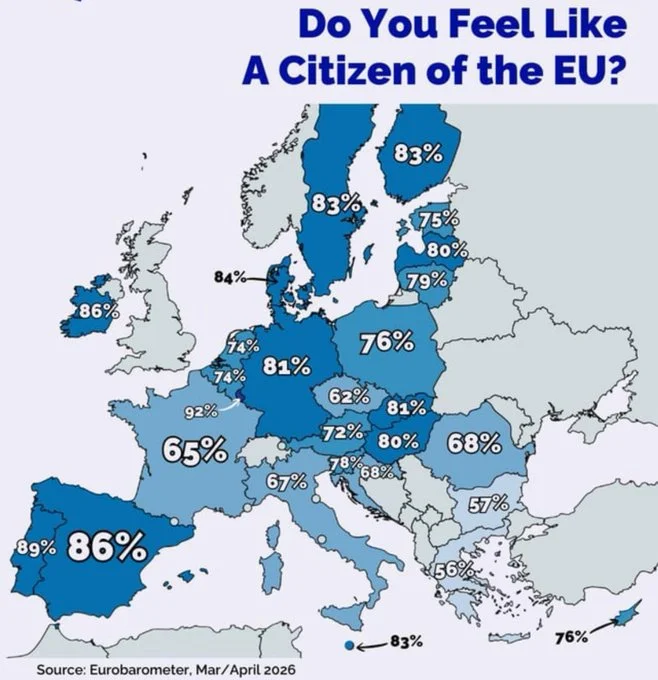
The old rule advises never to trust a statistic one has not falsified oneself. The European Union has refined the principle: there is no need to falsify a statistic when one can ask a question whose answer already contains the desired conclusion.
The map does not show how many people want the EU transformed into a federal state. It does not ask whether national vetoes should disappear, whether further powers should be transferred from national parliaments, whether taxation should be controlled from Brussels or whether EU law should expand into areas still governed nationally.
It asks people who are already legally citizens of the European Union whether they feel like citizens of the European Union.
The Standard Eurobarometer was commissioned by the European institutions and conducted among 26,415 EU citizens between 12 March and 5 April 2026. The European Parliament subsequently celebrated the result as a return to the highest level ever recorded.
The less harmonious figures remain visible for those prepared to inspect the map rather than absorb its headline. Only 56 percent in Greece gave the approved answer, followed by Bulgaria at 57 percent and Czechia at 62 percent. France reached 65 percent and Austria 67 percent. The Parliament’s own summary confirms that Greece, Bulgaria and Czechia produced the lowest results.
This means that even after asking citizens whether they feel like something they already legally are, nearly half of Greeks and more than one third of French and Austrian respondents still declined to experience the appropriate emotion.
Naturally, this is a triumph.
The EU propaganda you are encountering on various social media is not spontaneous enthusiasm posted by an unusually excitable Belgian with twelve EU flags in his bedroom. It was institutional communication, produced by people paid to promote the institution and financed by the same citizens whose emotional attachment was being measured.
The European Parliament’s 2026 budget allocates €26.53 million to “publication, information and participation in public events.” The official budget explanation says this money may be used to give Parliament a “recognisable, coherent and positive public image,” finance communication through grants and “multiplier networks,” monitor public opinion, raise Parliament’s social-media profile and produce web clips and other multimedia material.
You might also like