Eleven Times a Charm: The Tide Is Turning, Cluster 6, an Order and European Values Have Never Looked More Flexible
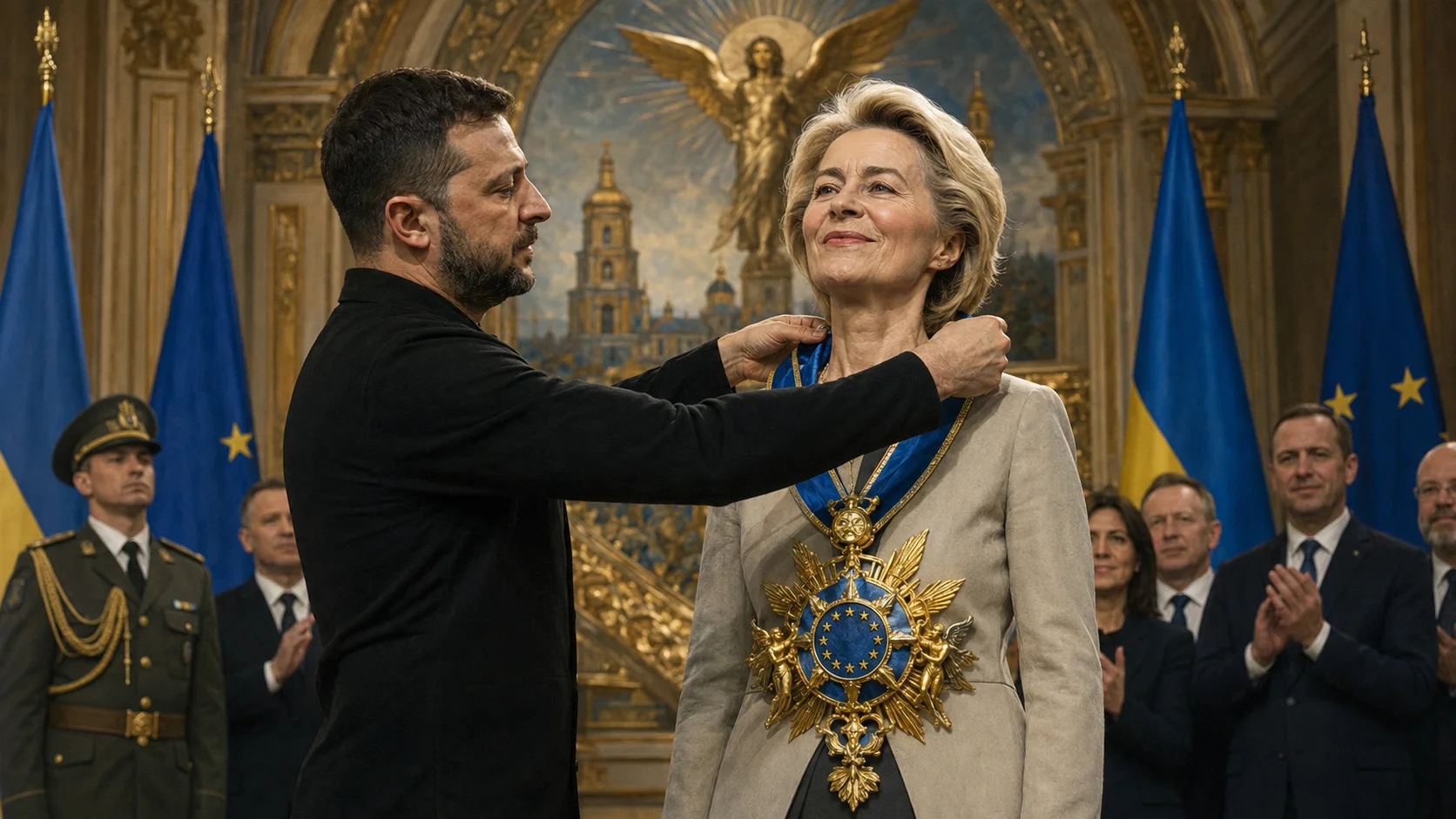
She received the first-ever “Order of Europe” from President Zelenskyy during Ukraine’s Statehood Day celebrations. Zelenskyy created the award specifically and stated publicly that it “can never be revoked or taken away.”
The visit follows the opening of Cluster 6 on external relations in Ukraine’s accession negotiations.
Accession on European Terms - Cluster 6 Opens Second
“It’s a special moment,” von der Leyen declared, explaining that Ukraine had built “strong military momentum” and promising new initiatives to integrate Ukrainian and European defence industries so that both could “produce more, and faster.”
The announcement sounds particularly impressive because “Cluster 6” creates the natural impression that Clusters 1 through 5 have already been completed.
Ukraine has opened exactly two clusters. Cluster 1, covering the fundamentals of membership, was opened on 15 June 2026. Cluster 6 was opened on 14 July.
Formal accession negotiations began in June 2024, while the screening process was completed in September 2025.
Cluster 6 was simply opened second because the clusters are thematic rather than chronological.
Its two chapters concern external trade and the alignment of foreign, security and defence policy, including sanctions and other restrictive measures. This is convenient, since in these areas it is becoming increasingly difficult to tell whether Ukraine is aligning itself with the European Union or whether the European Union has simply hired Ukraine to pursue its foreign-policy objectives.
The difficult matters remain in Cluster 1, which covers the judiciary, fundamental rights, democratic institutions, public procurement, financial controls and the fight against corruption. Under the EU’s own methodology, the fundamentals cluster must be opened first and closed last.
This means Brussels can celebrate rapid movement in defence and foreign-policy integration while ignoring corruption and democratic pluralism.
Winter Preparations and the Price of Alignment
Ukraine enters the coming winter with significantly reduced electricity generation capacity.
The war has left the country with roughly one-third of its pre-war output.
The EU has committed substantial support for repairs, decentralised generation, and emergency equipment.
At the same time, European industrial energy prices remain substantially higher than those in the United States and China. The shift away from previous pipeline supplies (and nuclear energy - in Germany) has imposed lasting costs on energy-intensive sectors.
Households across much of the EU continue to face bills well above pre-2022 levels.
The current arrangement therefore involves a double transfer - European taxpayers and consumers finance both military and reconstruction aid to Ukraine while absorbing the structural consequences of the energy realignment that accompanied the conflict. Whether this balance is sustainable over several more winters is an open question in several member states.
Values? What values?
In 2022, receiving an honorary doctorate at Ben-Gurion University, Ursula von der Leyen described Europe as rooted in “the values of the Talmud” and invoked Simone Veil, Hannah Arendt, Mahler, Kafka and Freud. Four years later, she became the first recipient of Ukraine’s newly created Order of Europe.
Four years later, the same European institutions have raised little objection to Ukraine’s decision to grant state honours to Andriy Melnyk, the former OUN-M leader who collaborated with Nazi military intelligence and publicly aligned himself with Hitler’s “new order.”
President Zelenskyy attended the reburial ceremony in May 2026. The move drew criticism from Yad Vashem and the Israeli government.
This sits within a wider pattern. Since 2015, Ukrainian legislation has elevated the status of wartime nationalist formations, including those responsible for the massacres of Poles in Volhynia in 1943 and for participation in anti-Jewish violence during the German occupation.
The European Union has largely treated these questions as matters of Ukrainian historical memory, secondary to strategic objectives.
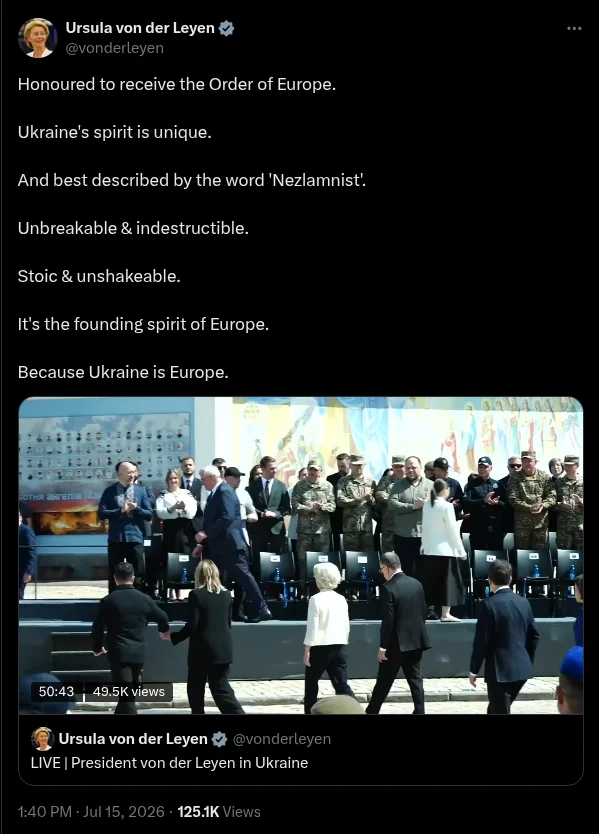
Ursula von der Leyen has discovered the founding spirit of Europe. It is not to be found in Athens, Rome, Paris, Berlin, the Renaissance, the Enlightenment or the ruins of the 20th century. It is called Nezlamnist.
Unbreakable, indestructible, stoic and unshakeable. And it comes from Ukraine - a non-EU state.
The real essence of the continent, it turns out, was only properly revealed in Kyiv after 2022.
Having just received the first-ever Order of Europe from President Zelenskyy, she concluded that “Ukraine is Europe.” Not in the geographical or institutional sense, but in the deeper, almost mystical sense that its spirit now defines the continent.
Russia is Europe too
Geographically, historically, and culturally, Russia is part of Europe.
A large part of Russia lies west of the Urals, which has been the traditional geographical boundary of Europe for centuries.
Russian history is deeply intertwined with European history - from the Kievan Rus, through the Tsardom, the Russian Empire, and the Soviet Union. Major European events (Napoleonic Wars, World War I, World War II, the Cold War) cannot be understood without Russia’s role.
Russia produced some of the greatest European cultural figures: Tolstoy, Dostoevsky, Chekhov, Tchaikovsky, Stravinsky, Kandinsky, Malevich, etc. It participated in the European intellectual tradition for hundreds of years.
When von der Leyen says “Ukraine’s spirit is the founding spirit of Europe” and “Ukraine is Europe,” she is not making a neutral historical statement. She is making a political one.
If Ukraine’s spirit is Europe’s founding spirit, then opposing the current policy becomes opposing Von der Leyen's Europe itself.
This redefinition is being pushed by institutions whose leadership already struggles for legitimacy across much of the continent. Large parts of European public opinion have shown consistent reluctance toward deeper entanglement in the conflict and the costs that come with it.
The real audacity is not just the rewriting of history, but the assumption that European societies will quietly accept a new founding myth - one that conveniently justifies current policy while they absorb the economic and strategic consequences. Whether this reflects strategic necessity or simple elite detachment is the question that will outlast the current narrative.
Sources
Mohlo by vás zaujímať