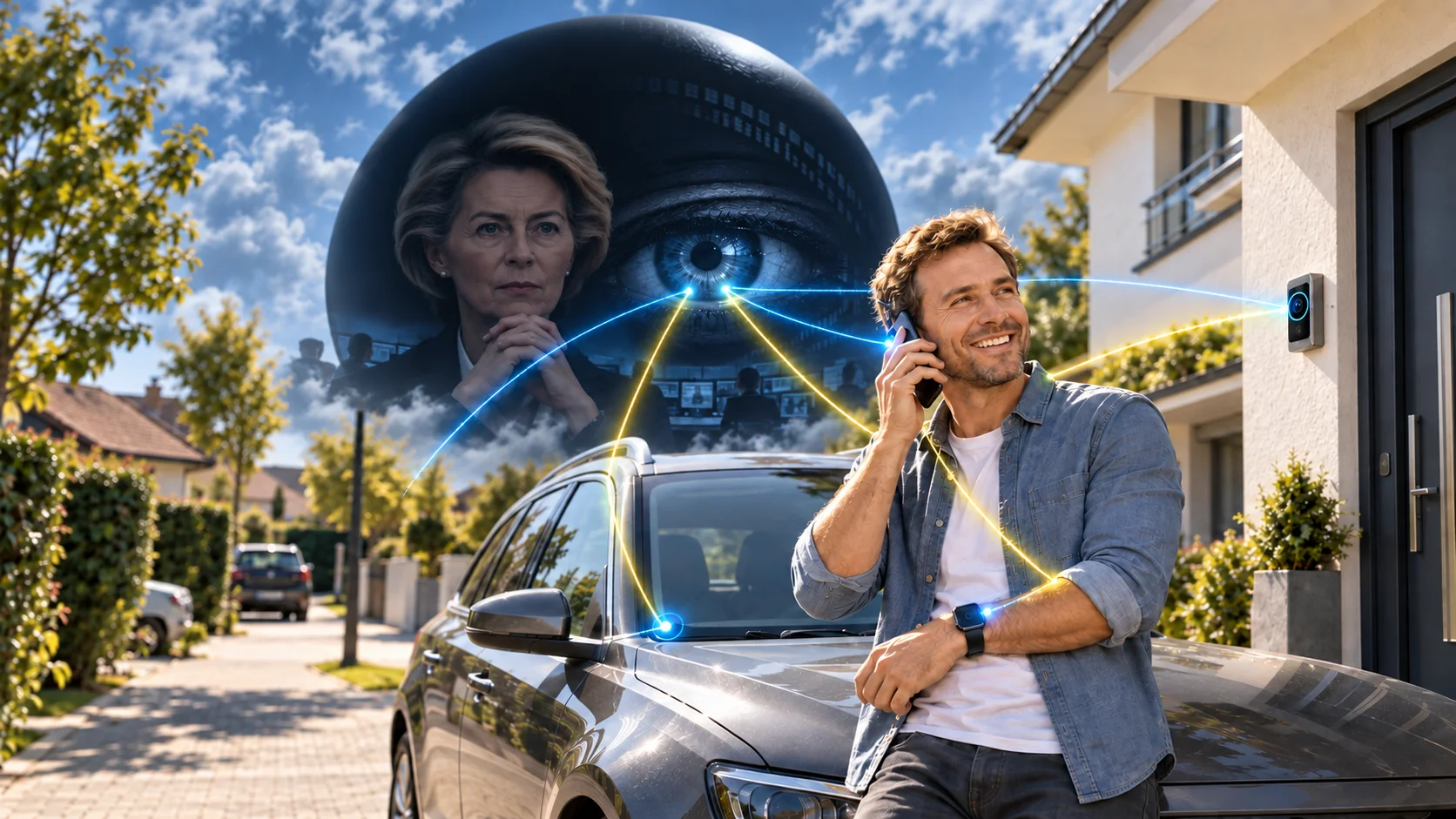
EU Kills Anonymity Online by Going Through Your Children
1 - A platform can be built so it does not turn a photo into porn with one tap, yada yada. That is engineering and commercial law aimed at the provider company.
2 - Protecting children is parent's problem.
Let's talk clear text here, because while the author's child (mine) is an adult (tomorrow - congratz my precious), this overreach makes me livid.
The state does not raise your children.
You do.
What they watch, play, read, eat, wear and whom they speak to in your house is not a Union competence dressed up as “childhood.”
There is no article in the Charter that says DG CONNECT shares custody.
Exceptions - you may not torture a child, starve a child, or make a child the object of a crime.
The Kids Act crosses that line the moment it says "this minor may not use this service unless a parent account, a timer, and a state age proof say so". That is the state assigning itself a role inside the family. It doesn't belong there.
That said, let's take a look at the reality, compared to what the EU is proposing.
In Greece
- From 8: Juvenile system can intervene (reformatory / therapeutic measures)
- From 15: Juvenile detention possible for serious offences
- 17: Voting
- 18: Adult
Children can vote at 16 in Austria and Malta (all elections), and at 16 for the European Parliament in Germany, Belgium and Malta.
What the Kids Act uses
- Under 13: no social media plus the “risky services” bucket
- 13–15: only a parent-built mini account, limited features, 1 hour/day.
- 15–18: own account, still under mandatory “safe by design.”
- Adults: age-checked anyway, because that is the only way the child rule can be enforced.
Fines for not complying run to 6 percent of worldwide turnover, which is the Commission’s way of saying they need more of that "own" money.
They wanna enforce this on social networks, video-sharing platforms, online games, AI chatbots and companions, app stores and operating systems.
The rights they are stepping on
For adults:
- Private life and correspondence (ECHR Art. 8, Charter Arts. 7–8). Making you prove an official attribute before you may use services is a privacy interference. France’s Constitutional Council already killed a national under-15 social-media ban in August 2026 on exactly this point: to keep children off, every adult would have to show age, and that was not a proportionate limit on privacy.
- Expression and information (ECHR Art. 10, Charter Art. 11). An anonymous public square is part of that right.
- Not being forced into a digital identity system as the price of reading, chatting, or playing.
For children:
- Privacy of the child (UNCRC Art. 16). Parent-supervised “mini accounts” can become a legal channel for household surveillance, not only platform safety.
- The child’s own speech and information rights (UNCRC Arts. 12–13, 17). A 14-year-old is not a toddler.
- Best interests of the child (Charter Art. 24). This is the clause Brussels quotes. It cuts both ways: protect from harm and not crush the child’s other rights with a blunt ban.
For parents:
- Family life. Liberal constitutions assume the default educator is the parent, not DG CONNECT. The state can ban selling cigarettes to a 12-year-old. It does not get a remote control on the household phone.
Pedagogy - there isn’t any.
Hate, pile-ons, sexualised slop, scams, a bot that calls itself your friend - you don't magically master these on the morning of the cake. The only way a person learns to swim is by swimming, with someone on the bank who watches - the parent.
If the design is poisonous at 13, it is still poisonous at 60. Using or not using these apps is the user's decision.
Illogical nonsense
Children do not, as a rule, “join social media.”
They join games - Roblox, Fortnite, Minecraft, a football manager, a Switch, Steam.
Sometimes, these come with chat.
Funnily, the proposal does not only restrict chat inside games. It puts an age check on the store itself, even for single-player games with no social features.
Why?
Anonymity - Security - Verification. Pick TWO.
Verification means the site is required to know that you are the person who owns the account.
Security here means that check is hard to fake.
Anonymity means the site, or the state, does not get a stable link to who you are.
The combinations:
- Anonymous + verified - The site only gets “someone is over 15.” Then a second phone, a relay, or a borrowed adult works. The check does not hold.
- Anonymous + secure - You never identify yourself and the system is hard to cheat. Then you cannot run a mandatory age gate for a whole population. There is nothing reliable to attach the “over 15” to.
- Verified + secure - The proof is tied to this person, this device, this session. Anonymity not possible.
The Commission’s text claims all three and I call bullshit.
This shall be enforced by the same mini-wallet age app the Commission declared technically ready in April, which got hacked in 2 minutes and after "security updates", it got hacked again, by a Chrome extension, later.
Wrong tool
People who already commit crimes do not sign up with a passport and wait for a mini-account. They use whatever is not in the Commission’s list.
When one platform is locked, another appears: smaller, foreign-hosted, less moderated, harder to see. You do not remove the demand. You move it.
The Act is good at burdening Google, Valve, OpenAI, and anyone who wants to stay legal in the EU. It is weak against the actual offender and leaky against the actual teenager.
If they were serious about harm to children, they'd need to do the classical police work.
Investigate grooming, extortion, CSAM, threats, fund coders who can follow a case across platforms, make companies keep and hand over data when there is a suspect, under a warrant.
Which leaves us with only one deduction - this is a law against free speech in general.
They know. We know. They know that we know. We know that they know that we know.

You might also like