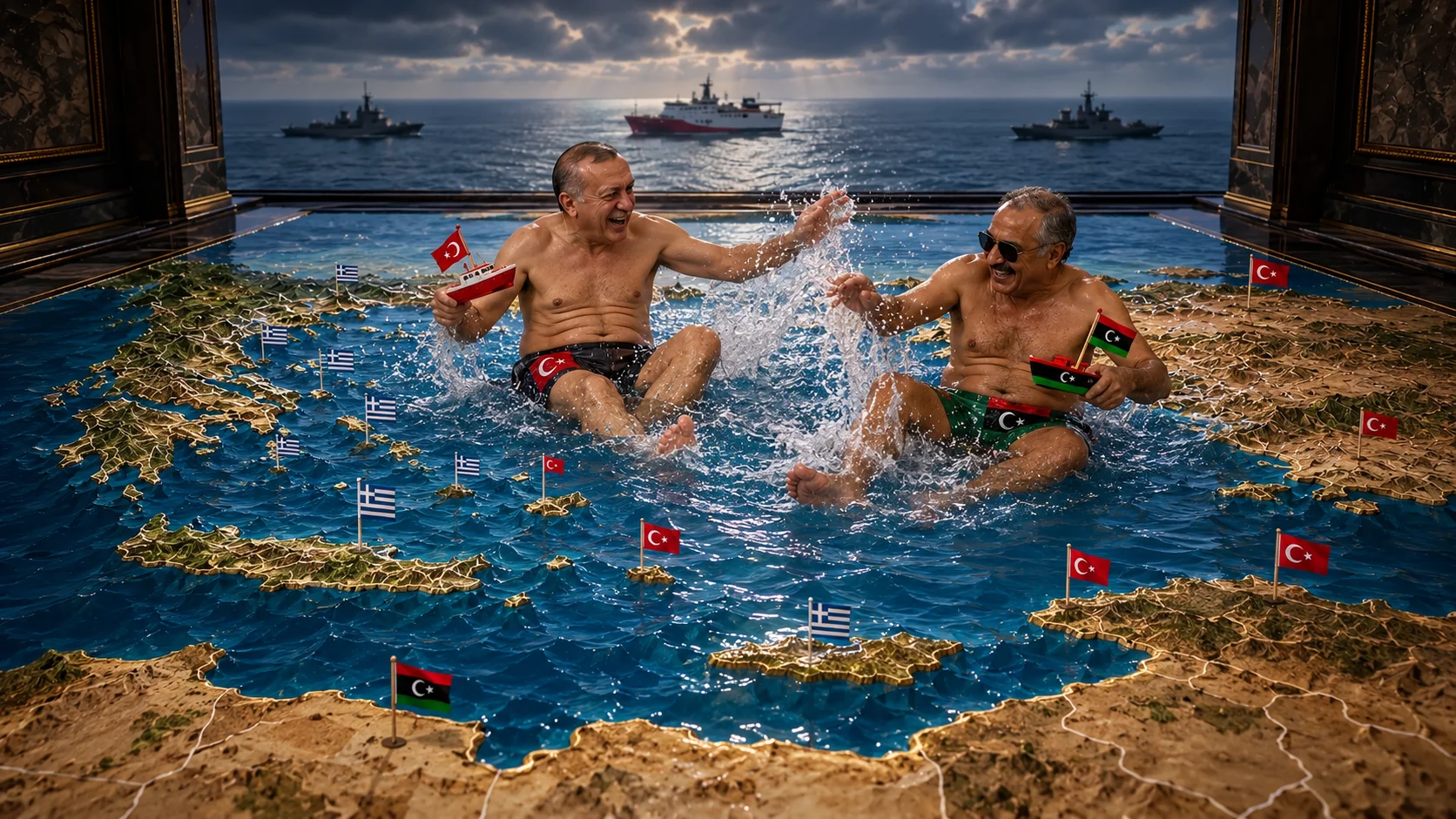
Turkish Sultanate supports their Turkish Cypriot brothers with an illegal bidirectional pipeline - escalation imminent?

On 10 July 2026, Turkish Vice President Cevdet Yılmaz and Energy Minister Alparslan Bayraktar travelled to the occupied areas and signed a memorandum of understanding with the Turkish Cypriot authorities.
The plan: two parallel 22-inch pipes running from Anamur on Turkey’s southern coast to the Teknecik power station near Kyrenia.
Roughly 97 kilometres will lie under the sea.
The system is designed to be bidirectional - gas can flow south to keep the lights on in the north, or reverse direction later if someone discovers more hydrocarbons in the Eastern Mediterranean and decides Turkey should be the transit hub. Target completion: 2028.
Official Turkish messaging presents this as brotherly solidarity.
The island currently relies on expensive liquid fuel for electricity. A pipeline will lower costs, improve energy security, and - according to some statements - even serve as a “bridge of peace” - built exclusively with the occupying power.
The Republic of Cyprus disagrees.
Under international law, including the United Nations Convention on the Law of the Sea (UNCLOS) and relevant UN Security Council resolutions, the unilateral development of strategic energy infrastructure on the territory and in the maritime zones of the Republic of Cyprus without its consent violates its sovereignty and sovereign rights.
The European Union’s foreign policy chief Kaja Kallas publicly reminded Turkey that it is expected to respect the sovereignty of all member states.
To prepare the seabed for this act of fraternal infrastructure, Turkey has issued a NAVTEX valid until the end of August for related works in the Mediterranean. The vessel associated with these activities is the familiar Oruç Reis.
The same seismic research ship that, in the summer of 2020, violated Greek continental shelf waters south of Kastellorizo while being escorted by Turkish warships.
That deployment produced the most serious military confrontation between Greece and Turkey in decades: fleets shadowing each other, a collision between the Greek frigate Limnos and the Turkish Kemal Reis, high-level warnings, and NATO and EU diplomatic scrambling before the ship was eventually withdrawn under pressure.
In 2022 the pattern threatened to repeat. Greek authorities placed the fleet on alert amid indications that the Oruç Reis could again be sent into Greek continental shelf waters, including the triangle between Rhodes, Karpathos and Kastellorizo. Rhetorical escalation from Ankara accompanied the technical preparations.
Now, in July 2026, the Oruç Reis has again left port (this time from Silifke, on the anniversary of the 1974 Turkish invasion of Cyprus) while a new NAVTEX covers pipeline-related surveys.
Greece is monitoring the movements closely.
~~~
This is the sultanate's logical next step in a long-running policy: normalise the occupation through physical infrastructure, create irreversible faits accomplis, and expand the operational space of the “Blue Homeland” doctrine.
Water already flows under the sea from Turkey to the north, while the southern part relies on modern desalination plants. Each new pipe is directed to make the political division of the island more permanent.
Turkey is trying to consolidate control over the territory it has illegally occupied since 1974 while using the same methods - NAVTEX declarations, seismic vessels, and managed diplomatic crises - that nearly produced an open conflict with Greece six years ago.
Turkey and the Gas Fields in the Mediterranean
In face of the inflation and economic stagnation, Turkey, instead of being a good neighbor, continues it's expansionist, aggressive policy.
Major Western energy companies are treating the Eastern Mediterranean as a serious long-term gas province - while Turkey tries to complicate or claim ownership.
Cyprus – Aphrodite field
US Chevron is the operator of the Aphrodite gas field in Block 12 of the Republic of Cyprus’s Exclusive Economic Zone, with a 35% stake. Partners are Shell (35%) and Israel’s NewMed Energy (30%).
- Reserves estimates are generally placed in the range of roughly 3.5–7 trillion cubic feet.
- Development concept: a floating production unit (FPU) in Cypriot waters with initial capacity around 800 million cubic feet per day, connected by pipeline to Egypt.
- As of July 2026, the partners (plus the Cyprus Hydrocarbons Company) have signed a memorandum of understanding with Egypt’s EGAS for the sale of all recoverable gas from Aphrodite to Egypt. Binding sales and host government agreements are still being finalised.
- Front-end engineering design (FEED) is underway. Final investment decision is targeted for 2027, with first gas currently projected around 2031.
Chevron has publicly described Cyprus as a key part of its Eastern Mediterranean portfolio. The company is using Egypt’s existing infrastructure (pipelines and LNG plants) rather than building expensive standalone export facilities in Cyprus.
Greece – Crete and southern blocks
In 2025–2026 Chevron entered Greece in a big way. Together with Helleniq Energy (70% Chevron operator / 30% Helleniq), it was awarded four large offshore blocks:
- South Crete 1
- South Crete 2
- South of the Peloponnese
- Block A2
These cover roughly 47,000 km² of ultra-deep water south of Crete and the Peloponnese. Lease agreements were signed and ratified by the Greek Parliament in early 2026. The first phase is seismic surveys (2D and 3D). Exploratory drilling, if the data justifies it, is years away (likely into the 2030s).
The geological setting is considered prospective, and Chevron’s willingness to take a large operated position is a strong signal of interest.
The wider Eastern Mediterranean picture
The region already has major proven gas resources:
- Israel (Leviathan, Tamar and others)
- Egypt (Zohr and additional fields)
- Cyprus (Aphrodite, plus other discoveries such as Glaucus and Cronos)
Egypt has positioned itself as the main processing and export hub because it already has LNG plants and pipeline infrastructure. Cyprus and Greece are developing their own resources either for domestic use, pipeline export to Egypt, or longer-term options.
Turkey systematically opposes these projects. It does not recognise the Republic of Cyprus’s EEZ, claims ownership over large parts of the Eastern Mediterranean belonging to Greece under international law under its expansive and illegal “Blue Homeland” doctrine, and has repeatedly used seismic vessels (especially the Oruç Reis), warship escorts, and NAVTEX declarations to assert its claims in foreigh waters and harass exploration.
The illegal pipeline project to occupied northern Cyprus is the latest example of trying to create parallel facts on the ground while major Western companies work with the legitimate governments of Cyprus and Greece.
Here goes your "strategic partner".
Why Eastern Mediterranean gas should matter to the rest of the EU
For most EU countries the Eastern Mediterranean still feels distant. It should not. Three straightforward reasons make the gas resources off Cyprus and Greece strategically interesting for the Union as a whole.
1. Diversification that is geographically close
Europe spent years and large sums reducing dependence on Russian pipeline gas after 2022. The lesson was simple: over-reliance on any single external supplier creates leverage that can be used against you.
Eastern Mediterranean gas is not a complete substitute for Russian volumes, but it is one of the few substantial new sources that sits inside or immediately adjacent to the European neighbourhood. Cyprus is an EU member state. Greece is an EU member state. Egypt already has LNG infrastructure that can (and does) send cargoes into European terminals. A developed Aphrodite field feeding into the Egyptian system, plus potential future discoveries south of Crete, adds molecules that do not have to cross Russian, Iranian or other high-risk corridors.
2. Supporting the sovereign rights of two EU member states
Turkey’s systematic campaign against Cypriot and Greek maritime rights is not a bilateral Greek-Turkish or Cypriot-Turkish quarrel that the rest of Europe can safely ignore. When Ankara sends seismic vessels escorted by warships into Greek continental shelf waters, issues illegal NAVTEX declarations, or builds infrastructure with the occupied north of Cyprus while rejecting the Republic of Cyprus’s EEZ, it is directly challenging the legal order that every EU member state relies on.
If the Union is unwilling or unable to defend the sovereign rights of Cyprus and Greece in their own maritime zones, the message to every other member state (and to outside powers) is that European legal commitments are selectively enforced.
US/Israel’s long-term presence in both countries, creates a practical counterweight.
3. A realistic bridge fuel in a difficult decade
The EU’s climate targets are "ambitious". The physical reality of the 2020s and early 2030s is that gas will still be required for power generation, industry and security of supply while renewables and storage scale up. Preferring gas that comes from relatively stable, democratic partners inside the European neighbourhood over gas that strengthens authoritarian suppliers is both pragmatic and consistent with the Union’s broader foreign-policy rhetoric.
Should EU miss the opportunity to support their Greek/Cypriot members, it could happen that these resources will be used by somebody else.
Sources
You might also like