Who Needs Gas or Oil? The World Is Moving To The Next Stage Of Planetary Evolution (not the EU)
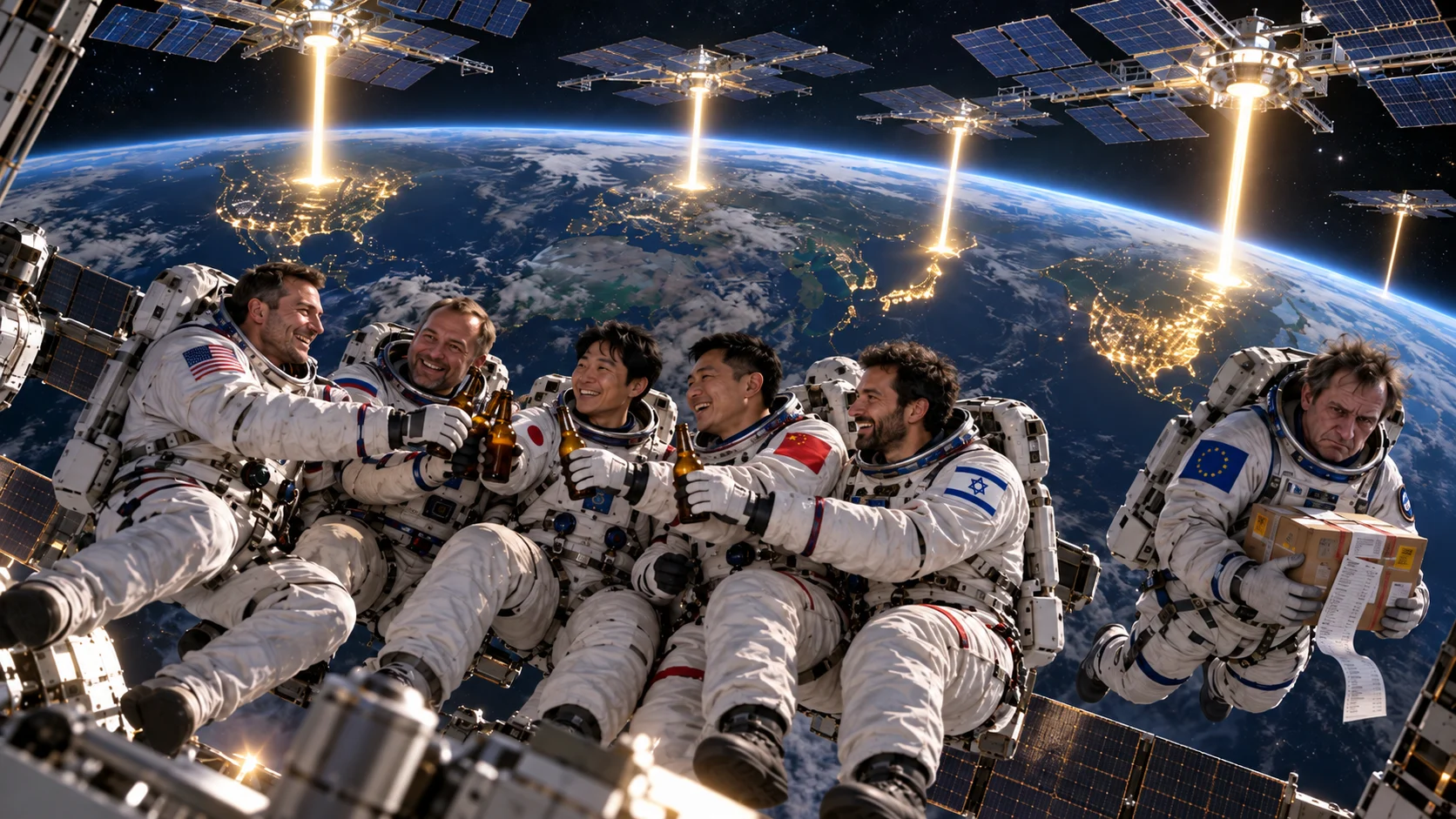
The U.S. military has now moved beyond the old “perhaps one day we could beam solar power from orbit” stage and is funding several different projects of a space-power architecture.
In July 2026, the Defense Innovation Unit asked companies for a near-term low-Earth-orbit power-beaming demonstration capable of sending energy both space-to-space and space-to-ground, with the longer-term objective of an operational multi-orbit capability around 2030. The military applications it listed include forward bases, unmanned systems, edge computing and in-space manufacturing.
Katalyst Space’s ASGARD program
On September 21, 2026, Katalyst announced that the Department of War’s Operational Energy Capability Improvement Fund had selected it to develop and launch a robotic spacecraft that would assemble a large power-beaming structure in orbit and transmit power back to Earth.
Katalyst is pursuing a microwave system. Its ASGARD spacecraft would assemble a large structure in orbit using robotic equipment. Solar electricity would then feed microwave-generating conversion tiles developed from Naval Research Laboratory technology. The microwave beam would travel to a large rectifying antenna (rectenna), which converts the radio-frequency energy back into ordinary electricity.
Nine days later, the Department of War fund awarded another contract to Overview Energy.
Overview is pursuing an optical system. It wants satellites in geosynchronous orbit, around 35,786 kilometres above Earth, collecting sunlight and converting the electricity into a tightly controlled near-infrared beam.
The new military contract is specifically for the ground-side homing beacon that tells the satellite exactly where the receiver is, authenticates it, and lets the spacecraft lock its beam onto it.
Rather cleverly, Overview wants to send that energy to existing photovoltaic infrastructure.
The Pentagon is not treating this merely as exotic renewable energy. Its principal attraction is logistics.
A remote military base presently needs fuel brought by ship, truck or aircraft. Every litre requires transport infrastructure, personnel and protection. A power-beaming satellite changes the equation.
The Air Force Research Laboratory explicitly describes the goal as moving vulnerable military energy supply lines into space.
~
The really interesting future tech may not even be supplying Earth.
Imagine satellites that do not need enormous solar arrays themselves. A dedicated orbital power station supplies them. Lunar equipment receives energy during the lunar night. Orbital factories receive megawatts without hauling gigantic generation systems everywhere. Electric spacecraft recharge remotely. Space telescopes can operate in locations where their own solar geometry is lousy. You get an electrical grid in space.
Star Catcher is pursuing a slightly different version. Instead of primarily sending electricity down to Earth, its system collects solar power and beams concentrated laser energy to other spacecraft.
Its first orbital demonstration is now planned around its Protostar spacecraft. The company has received a $30 million U.S. Space Force award and says it already has commercial power-purchase agreements and letters of intent.
The U.S. military has actually been working toward this goal for years.
In 2020 the U.S. Naval Research Laboratory launched PRAM, the Photovoltaic Radio-frequency Antenna Module, aboard the X-37B spaceplane. It was only about 30 centimetres square, but it successfully tested the crucial first step: collect sunlight in orbit and convert it directly into microwave-frequency energy suitable for transmission.
The Air Force Research Laboratory's gloriously bureaucratically named Space Solar Power Incremental Demonstrations and Research project, or SSPIDR. Instead of building a conventional solar array connected by kilometres of cables to one huge transmitter, it uses modular “sandwich tiles.”
One side collects sunlight; electronics inside convert the electricity; the other side contains radio-frequency transmitters. Thousands or millions of tiles become both the solar farm and the phased-array antenna.
Northrop Grumman received a contract worth more than $100 million for this work in 2018. The planned orbital demonstrator, Arachne, was eventually cancelled because the Air Force Research Laboratory concluded that the ground program had already demonstrated almost everything it expected the orbital test to teach them. Rather than abandoning space solar, they redirected the effort toward larger systems and newer commercial approaches.
Another variation already receiving U.S. military money is Reflect Orbital. Instead of converting sunlight into electricity aboard the spacecraft, its satellites use mirrors to redirect sunlight itself toward Earth. The company received about $1.25 million through a U.S. military small-business award for technology intended to provide on-demand illumination and extend terrestrial solar generation after sunset.
The USA reached the point where nearly two decades of component experiments start turning into actual system demonstrations.
~
The US is very much not alone.
Japan has maintained a government research program JAXA, which has been studying Space Solar Power Systems for decades, including microwave transmission, laser transmission, enormous deployable structures, high-efficiency space photovoltaics and debris mitigation. JAXA describes the eventual system quite straightforwardly as a “power plant in space.” Its long-term goal remains practical deployment in the latter half of this century.
JAXA notes that solar intensity in space is roughly 1.4 times stronger than at Earth's surface, before terrestrial atmospheric losses are considered.
Japan has also performed important terrestrial microwave-beaming demonstrations.
Caltech.
Its Space Solar Power Project took a different route again: extremely lightweight foldable modules containing photovoltaics, electronics and phased-array transmitters. Caltech launched its Space Solar Power Demonstrator in 2023 and demonstrated wireless power transmission in space.
Its design philosophy is particularly attractive because failure of individual modules does not cripple the whole system. You build a gigantic power station out of huge numbers of cheap repeating elements.
~
Europe has ESA's SOLARIS initiative.
ESA has studied kilometre-scale geostationary solar-power stations supplying terrestrial grids and investigated the economics, robotics, wireless transmission and enormous orbital structures required. ESA's basic argument is the same one everyone eventually arrives at: sunlight in suitable orbit is much more predictable than terrestrial solar because there are no clouds, weather systems or ordinary day-night interruptions.
~
The United Kingdom has gone unusually far into the engineering and economic side.
The government funded the CASSIOPeiA architecture and associated transmission experiments.
In one project, researchers are testing electronically steered microwave beams at power densities above 200 watts per square metre. The UK government updated its work in February 2026 with a study specifically examining whether smaller early commercial systems could operate during the 2030s, instead of waiting until somebody finds the money to launch a gigawatt Death Star.
Projects geometry allows electronic beam steering with fewer moving parts. Space Solar, the company developing it, demonstrated 360-degree wireless energy transmission without mechanically rotating the transmitter in 2024.
~
China has also had a major space-solar research, including proposals for progressively larger orbital demonstrations leading toward megawatt and ultimately gigawatt systems.
Their underlying architecture is broadly the same family of ideas: enormous solar collection structures in orbit combined with microwave transmission to terrestrial rectennas.
~
Israel Aerospace Industries built Dror-1, Israel’s national communications satellite, which reached geostationary orbit at roughly 36,000 km in 2025. That is exactly the neighborhood many serious space-solar concepts want to operate in. Dror-1 uses deployable solar arrays, large communications antennas and autonomous station-keeping hardware.
Israel also has serious expertise in high-power radio-frequency systems, electronically steered antennas, radar, laser systems, electro-optics, spacecraft guidance and compact satellite design.
Ben-Gurion University developed lightweight, high-efficiency solar-panel concepts specifically for space use, and NASA tested Israeli-developed photovoltaic hardware on the International Space Station.
In December 2025, Israel and NASA signed a 10-year strategic space cooperation agreement covering 2025–2035, including joint technological projects, access to facilities and research resources, and participation in Artemis-related missions.
In May 2026, NASA then invited Israeli research institutions and industry to propose experiments and CubeSats for future Artemis missions.
In May 2026, Israel and the U.S. formally began negotiating a new defense cooperation framework designed specifically to expand joint investment in research, development and co-production.
We already see systems such as Arrow, where Israel Aerospace Industries, Israel's Ministry of Defense and the U.S. Missile Defense Agency jointly develop and test extremely sophisticated aerospace technology. The latest Arrow test was conducted in August 2026.
~
Russia is the odd one here. It absolutely has the technical heritage to do space-based power transmission, but there is no officially funded project around beaming solar power from orbit down to Earth.
Roscosmos is focused on the Russian Orbital Station, satellite constellations, communications, Earth observation and its lunar program. The new orbital station is now planned to begin deployment in 2028 and be built out through the early 2030s.
The orbital station is explicitly being designed as more than just another crew habitat. Energia has talked about using it as a servicing and control hub for nearby satellites, including deploying, repairing and potentially refuelling spacecraft.
Russian answer to the question of space power is nuclear electricity in space.
Already the USSR operated nuclear reactors in orbit.
Energia and KB Arsenal have discussed megawatt-class nuclear-electric systems for deep-space missions. In one Roscosmos meeting, KB Arsenal described the reactor-power project as enabling spacecraft with power levels far beyond conventional solar systems, although the program was still at preliminary design stage.
Russia also intends to build energy infrastructure on the Moon. Roscosmos has described a future Russian lunar base including its own solar power station, communications systems, scientific facilities and an orbiting satellite.
~
The race is therefore about who can make the mass and launch first.
Space Solar could start competing with nuclear, hydro and gas.
So by 2026 we have three distinct architectures being actively pursued: satellites that beam microwaves to Earth, satellites that beam infrared/laser energy, and satellites that redirect sunlight itself.
Here comes the EU rant.
While other nations are pushing for a working infrastructure, the EU had a surprisingly aggressive roadmap for SOLARIS. The old plan imagined ground demonstrations in 2023–25, a hundreds-of-kilowatts orbital demonstrator in 2026–30, a 100 MW pilot station in 2031–35, and then multi-gigawatt systems from roughly 2036 onward.
What actually got funded at its enormous November 2025 ministerial meeting - with €22.3 billion - were launchers, Earth observation, telecommunications, navigation, exploration and resilience.
EU hasremained very European about it: study feasibility, commission another study, establish a stakeholder group, assess socioeconomic implications.
Also, Europe presently doesn't have a reusable super-heavy launch vehicle.
The Commission's UNINSPIRED current solar strategy is about terrestrial photovoltaics. Its official targets include at least 700 GW of conventional solar PV by 2030, accompanied by mandates and incentives for putting panels on buildings.
Followed by censoring what people can read online and identity checks at every corner and let's not forget the packaging tax.
Sources
- katalystspace.com
- prnewswire.com
- overviewenergy.com
- afresearchlab.com
- breakingdefense.com
- wired.com
- navy.mil
- afrl.af.mil
- afresearchlab.com
- ard.jaxa.jp
- spacesolar.caltech.edu
- gov.uk
- assets.publishing.service.gov.uk
- sbir.gov
- tass.com
- tass.com
- commercialisation.esa.int
- space.gov.il
- iai.co.il
- space.gov.il
- space.gov.il
- mod.gov.il
You might also like