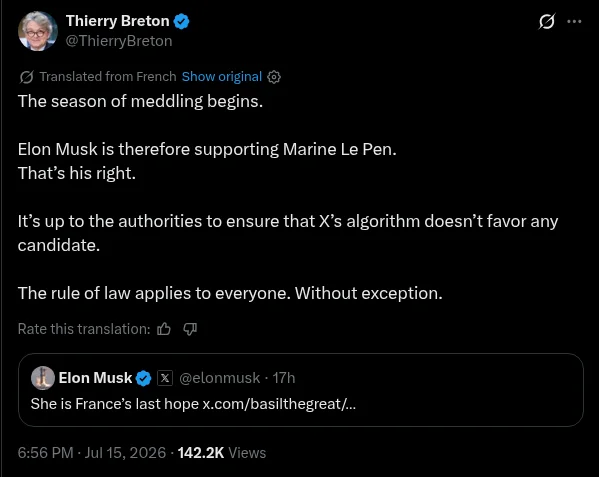
The Season of Interference Has Begun - Thierry Breton discovers that private opinions on X are a threat to democracy

Breton is magnanimous. It is, he concedes, Musk’s right to hold and express that view.
However - and there is always a however - it now falls to the authorities to ensure that X’s algorithm does not favor any candidate. The rule of law applies to everyone, without exception.
One can only admire the intellectual flexibility required to say this with a straight face.
At the exact moment Breton was typing, European law and national rules across multiple countries already required private platforms and digital interfaces to treat certain speakers more favourably than others.
Germany’s Media State Treaty is the clearest example for social networks and search engines. It protects journalistic-editorial offerings against systematic algorithmic disadvantage and allows designated “public value” content to receive privileged discoverability. Ordinary users do not enjoy this institutional shelter.
France goes further on interfaces and searches. It requires operators of smart televisions, internet provider interfaces and smart speakers to ensure “appropriate visibility” for designated services of general interest. Arcom’s rules cover not only home screen placement but also search and recommendation results. A search for one of the protected services should normally return it first.
Italy has moved past the question of visibility altogether. Its rules specify where approved media icons should appear - on smart TVs, set-top boxes, car infotainment systems and other devices. National providers such as RAI receive designated placement.
Spain imposes catalogue and search-promotion obligations for European works and content in co-official languages. Ireland has created statutory powers for the prominence of public-service content and is currently developing the guidelines.
The United Kingdom’s Media Act 2024 does something similar for designated public-service broadcasters on television selection services.
Above all of them sits EU law. Article 7a of the Audiovisual Media Services Directive explicitly authorises member states to require appropriate prominence for audiovisual services of general interest.
Article 18 of the European Media Freedom Act adds procedural protection: qualifying media providers on very large platforms must be notified and given time to reply before their content can be restricted.
It is, of course, pluralism, discoverability, media freedom and public value.
An algorithm only becomes a threat to democracy when it grants unplanned visibility to somebody outside that protected category.
Breton’s concern arrived rather late, but at least it arrived during the correct season.
Europe Enters the Season of the Witch Prepared
Thierry Breton should therefore be congratulated for recognising the danger at precisely the moment Europe had completed building the legal architecture needed to manage it.
The continent is now exceptionally well equipped.
Recognised media enjoy special algorithmic treatment.
General-interest services receive guaranteed prominence.
Search results, home screens, catalogues and recommendation systems may all be adjusted in the name of pluralism, cultural policy and democratic resilience.
Only the pesky unauthorised influence still remains a problem.
You might also like